Your pain is real. So is the science that can retrain it.
Flare uses graded motor imagery, pain neuroscience education, and somatic breathwork — delivered in ten-minute daily sessions that gradually retrain how your brain interprets pain signals.
No prescription. No waiting room. No fourth physiotherapist.
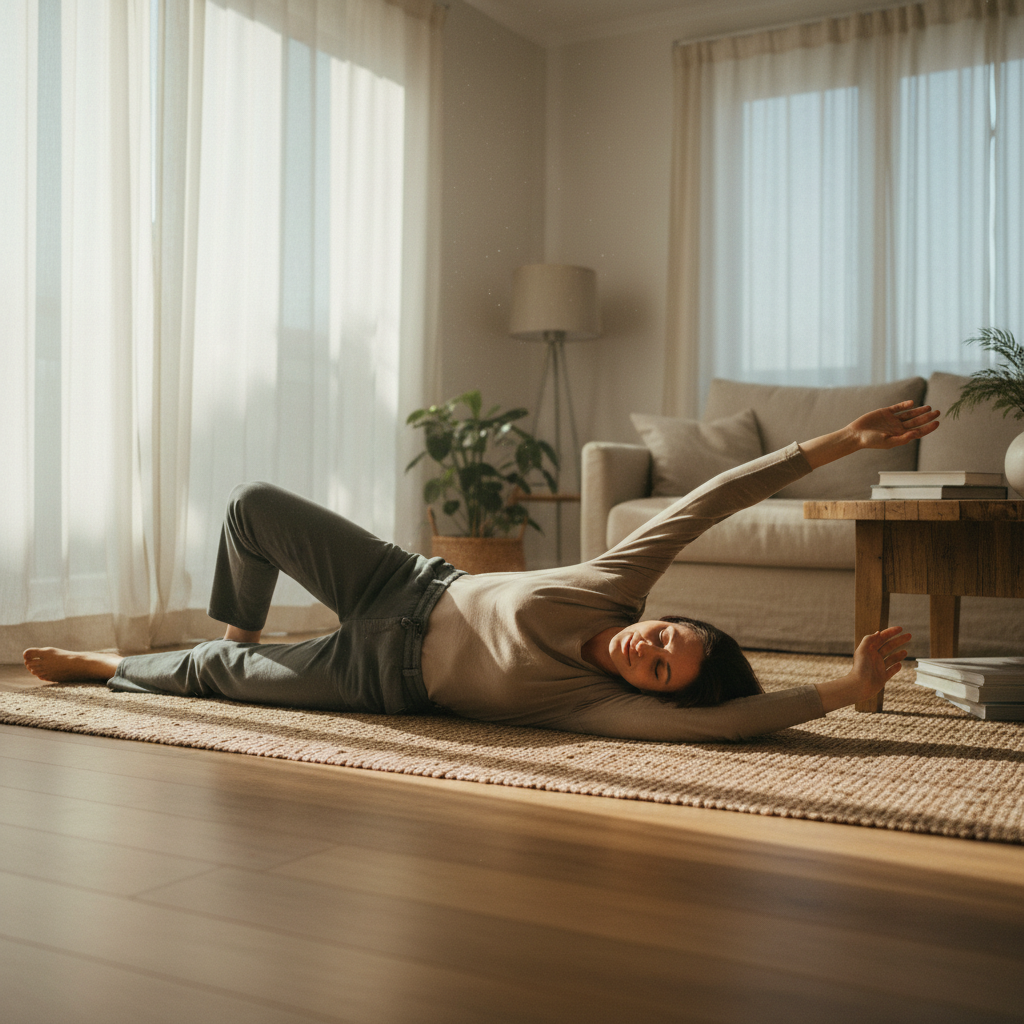
Session Complete
Day 7 · Breathwork & GMI
Five questions. A protocol made for you.
The audit maps your pain pattern against peer-reviewed intervention protocols. No diagnosis — just clarity.
Where does the pain live?
Select the area that troubles you most.
Three methods. One goal: a nervous system that stops sounding the alarm.
Each method targets a different layer of the pain experience — neurological, cognitive, and physiological.
Graded Motor Imagery
Your brain holds a map of your body. Chronic pain distorts that map — GMI corrects it through a stepwise progression of movement imagery, mirror therapy, and guided functional tasks.
When pain persists beyond injury healing, the nervous system itself becomes sensitized. GMI targets this directly: by rehearsing movement in imagination before attempting it physically, the brain's threat response is gradually recalibrated. No movement required in early stages.
GMI vs. standard physiotherapy in a meta-analysis of chronic pain patients
Moseley & Butler, 2015 · Cochrane-reviewed
Pain Neuroscience Education
Understanding pain changes pain. When the brain receives accurate information about why it's generating pain signals, the perceived threat decreases — and so does the pain.
PNE explains the biopsychosocial model of pain in plain language: why scans may show nothing while pain feels very real, how central sensitization works, and why past treatments may have failed. Literacy about your own nervous system is the first therapeutic act.
Symptom cluster for detecting central sensitization in low back pain
Nijs et al., 2020 · Clinical Journal of Pain
Somatic Breathwork
Chronic pain hijacks breathing — making it shallow, high in the chest, and stress-amplifying. Somatic breathwork reverses this by activating the parasympathetic nervous system directly.
A single session of diaphragmatic breathing significantly reduced perceived pain and anxiety in a study of 169 individuals with chronic pain. Slow, deep breathing lowers cortisol, reduces muscle tension, and interrupts the pain-stress-pain cycle that keeps chronic sufferers trapped.
Single breathwork session significantly reduced pain and anxiety scores
Hopper et al., 2019 · Journal of Pain Research
The people Flare was built for.
Marcus T.
Software engineer, chronic low back pain for 4 years
"I'd seen three physiotherapists in two years. Each one gave me exercises that made it worse. Flare was the first thing that explained why nothing was working — and then actually fixed it. My lower back pain went from an 8 to a 2 in six weeks."
Diane Okafor
Fibromyalgia patient, diagnosed 2019
"I have fibromyalgia. I found Flare at 2am during a flare-up, scrolling forums. The pain neuroscience education module made me cry — not from pain but because someone finally explained what was happening in my own nervous system."
James Whitfield
Post-surgical recovery, knee replacement
"Post-surgery I was told the opioids were a short-term bridge. When the prescription ran out, the ache was still there. Flare's breathwork protocol was the first thing that gave me relief without a pill. I sleep through the night now."
Ten minutes. Four phases. A protocol built from three decades of pain research.
Every Flare session follows the same structure — adapted daily to your pain log, progress data, and the specific pattern identified in your audit. No two sessions are identical, but every one is grounded in the same evidence.
Body Scan & Check-in
Somatic AwarenessA guided somatic scan locates tension and establishes a baseline pain reading. This primes the nervous system for receptivity.
Breath Protocol
Somatic BreathworkDiaphragmatic breathing activates the parasympathetic system. Cortisol drops. Muscle tension releases. The brain shifts from threat-mode to learning-mode.
Motor Imagery or Education
GMI / PNEAlternating daily: either a graded movement imagery sequence, or a short Pain Neuroscience Education module explaining one aspect of your pain pattern.
Cognitive Reframe & Log
Cognitive ReframingA guided reframing exercise challenges one pain-related belief. You log your pain score and one observation. The algorithm adjusts tomorrow's session.
No movement required in early sessions. Flare begins where you are — if you're in a flare-up, the protocol adapts. Motor imagery requires only imagination. Breathwork requires only breath.
Begin your first session free.
You've read the science. You've taken the audit. The next step is ten minutes — a session that begins where you are, not where you should be.
No credit card required · Cancel anytime · Evidence-based, not app-store wellness